About Me
I am a third-year PhD student in Computer Science at Facultad de Ciencias Exactas y Naturales, Universidad de Buenos Aires advised by Professor Daniel Acevedo. I received my combined B.S./M.S. in Computer Science from the same institution in 2023. My research focuses on developing energy-efficient face analysis methods based on neuromorphic systems for Driver Monitoring Systems (DMS). DMS typically involve multiple cameras, among other sensors, installed inside vehicles and their main goal is to ensure road safety by monitoring the driver’s state (physiological, emotional, kinesthetic) through bodily indicators.
In my thesis, I investigate whether event-based vision and neuromorphic learning can enable efficient and robust face analysis for DMS operating under real-time and resource-constrained conditions. I focus on analyzing facial and ocular dynamics relevant to driver state monitoring, including tasks such as gaze estimation, drowsiness detection, and facial expression analysis. Special emphasis is placed on developing learning methods compatible with neuromorphic systems, including spiking networks and reservoir computing approaches. In addition to my primary research, I collaborate on projects in video bronchoscopy analysis, developing deep learning methods for the detection of anatomical structures in bronchoscopy videos. All my research is supported by a doctoral fellowship from Consejo Nacional de Investigaciones Científicas y Técnicas (CONICET).
Beyond research, I have been teaching undergraduate Computer Science courses since 2018. I began as an Undergraduate Teaching Assistant and currently serve as a Graduate Teaching Assistant (Jefe de Trabajos Prácticos) at the Department of Computer Science, Facultad de Ciencias Exactas y Naturales, Universidad de Buenos Aires. I am also an Instructor at the Department of Technology and Science, Universidad de Quilmes.
News
- Presented our previous work Event-based Liveness Detection using Temporal Ocular Dynamics: An Exploratory Approach in the Poster Session at the ECCV Workshop on Neuromorphic Vision (NeVi), Malmö, Sweden 🇸🇪. Thanks to everyone who stopped by!
- Started a short research stay with Grupo de Sistemas Neuromórficos at Instituto de Microelectrónica de Sevilla, Spain 🇪🇸.
- Our paper High-frequency event-based Eye Tracking was accepted to Jornadas Argentinas de Informática (JAIIO) 2026, La Plata, Buenos Aires 🇦🇷.
- FG 2026, Kyoto, Japan 🇯🇵 — that's a wrap! Co-taught our tutorial Face and Gesture Recognition Using Event-Based Cameras, presented our paper Event-based Liveness Detection using Temporal Ocular Dynamics: An Exploratory Approach, and participated in the Doctoral Consortium and the poster session. A big thank you to everyone who attended our tutorial session!
- Presented our paper Event-based facial microexpression analysis using Spiking Neural Networks at ICRPS 2025, Viña del Mar, Chile 🇨🇱. Assisted at The Latin American Summer School on Robotics (LACORO) 2025 in Rancagua, Chile (got best PhD poster award!) and finished a short research stay at Universidad de O'Higgings.
- Presented at the Doctoral Symposium in IAPR/IEEE LATAM Summer School on Advanced Biometric Techniques 2025, Cancun, Mexico 🇲🇽
- Our paper Exploring spatial-temporal dynamics in event-based facial microexpression analysis was accepted to ICCV 2025, NeVi Workshop, Honolulu, Hawaii 🇺🇸!
Research Highlights BibTeX References

|
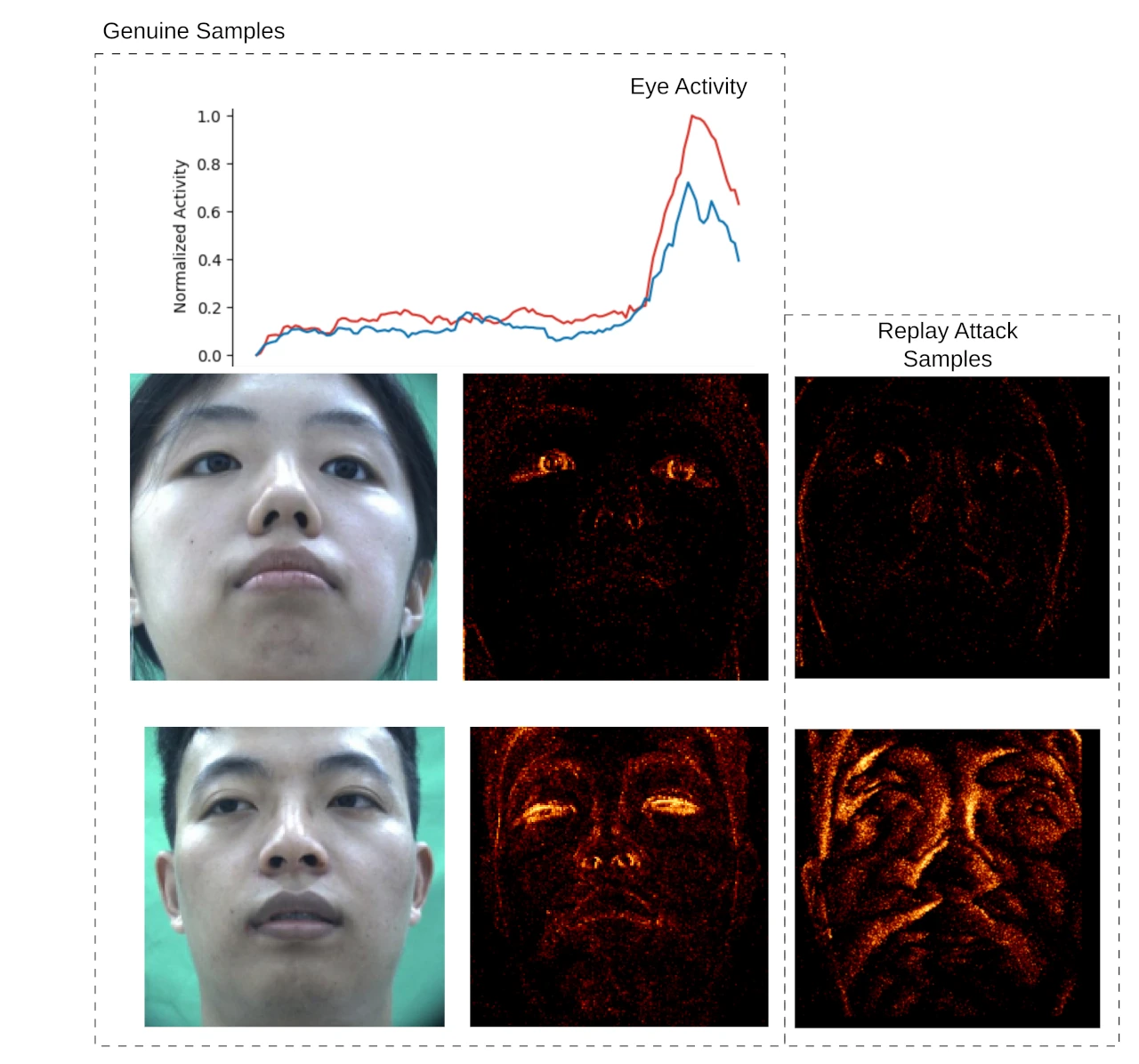
Event-based Liveness Detection using Temporal Ocular Dynamics: An Exploratory Approach
FG 2026, FME Workshop (Oral) PAPER CODE We explore event cameras as an alternative sensing modality for liveness detection based on temporal blink and saccade dynamics. Replay attacks cannot faithfully reproduce these dynamics due to temporal resampling and display artifacts, leading to distinctive spatio-temporal patterns in the event domain. We design a data collection protocol to extend RGBE-Gaze with replay-attack recordings, yielding an event-based fake counterpart for liveness detection. Our results show that event-based representations enable reliable discrimination between genuine and replayed sequences, achieving up to 95.37% top-1 accuracy with a spiking convolutional neural network. Nicolas Mastropasqua, Ignacio Bugueno-Cordova, Rodrigo Verschae, Daniel Acevedo, Pablo Negri, |
|
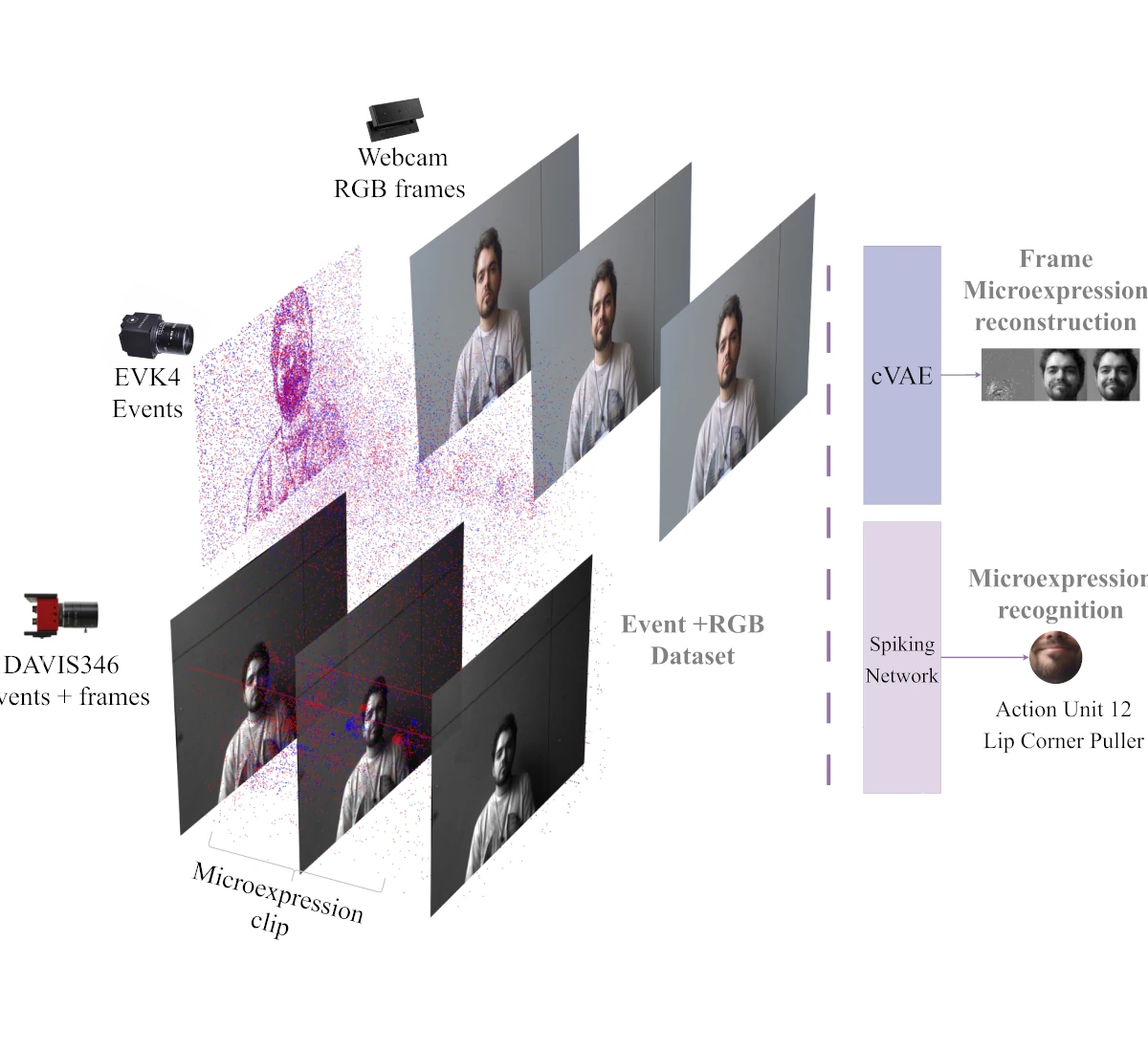
Exploring Spatial-Temporal Dynamics in Event-based Facial Micro-Expression Analysis
ICCV 2025, NeVi Workshop PAPER In this work, we introduce a novel, preliminary multi-resolution and multi-modal micro-expression dataset recorded with synchronized RGB and event cameras under variable lighting conditions. Action Unit classification using Spiking Neural Networks achieves 51.23 accuracy with events against 23.12 with RGB. We also perform frame reconstruction using Conditional Variational Autoencoders, achieving SSIM = 0.8513 and PSNR = 26.89 dB with high-resolution event input. Nicolas Mastropasqua*, Ignacio Bugueno-Cordova*, Rodrigo Verschae, Daniel Acevedo, Pablo Negri, Maria Elena Buemi, |
* denotes equal contribution.